
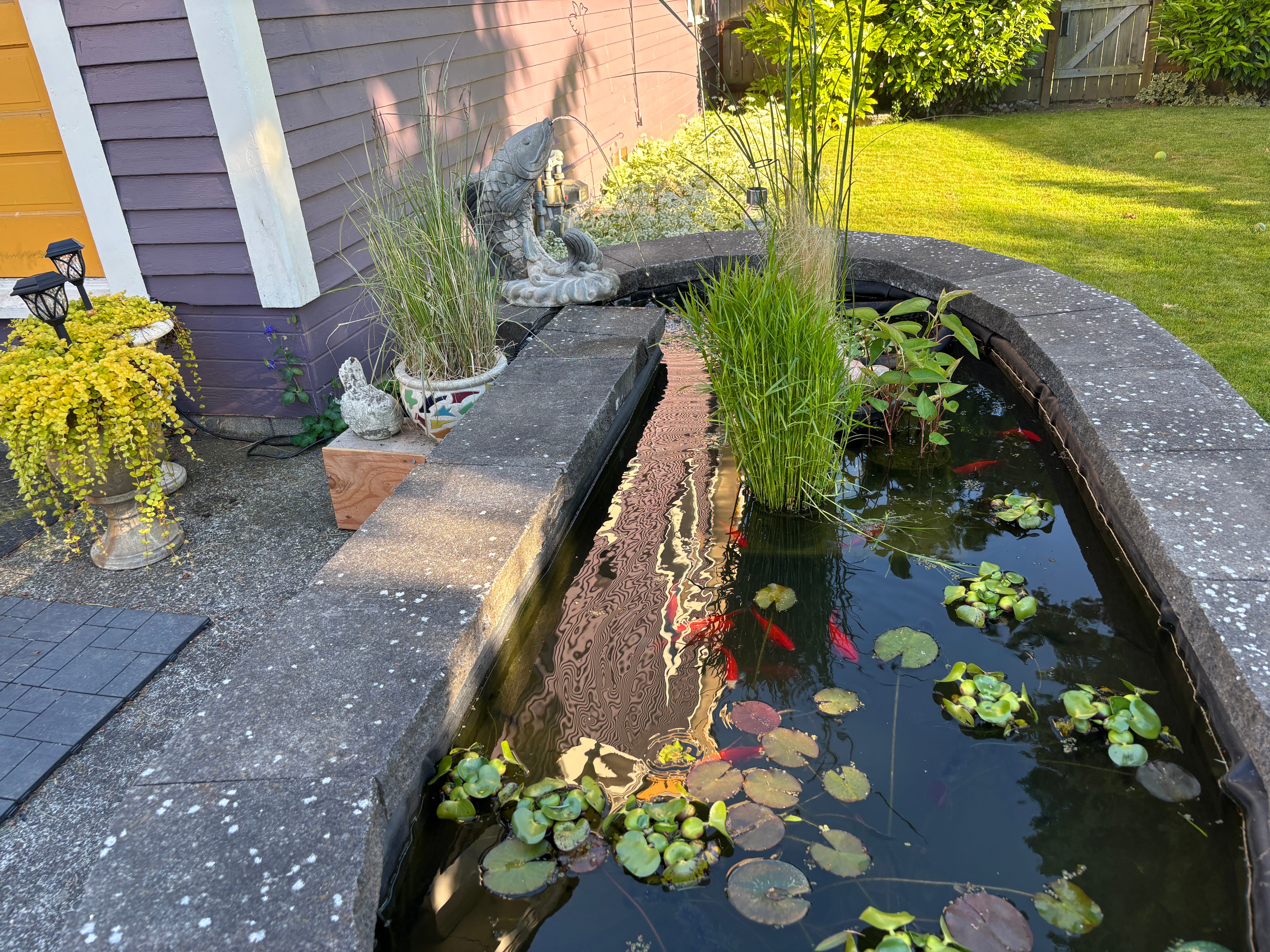
You’re right. The picture above is not the Lincoln Memorial Reflecting Pool. However, the title is not clickbait. The picture is the fishpond in my yard. I have delt with algae blooms for years. I may have finally found the answer.
Before we get into my solution, let’s look at some facts about the Lincoln Memorial Reflecting pool. The pool was built in 1923 and is about 2028 feet long and 167 feet wide. Almost from the beginning, the pool has suffered from structural failure, sinking, leaking, algae growth, and expensive repair efforts.
The Pool was built on former marshland near the Potomac River. Engineers at the time did not foresee the long-term settling that would plague the structure.
From the outset, the pool faced persistent maintenance issues. The concrete sank and cracked, which of course leaked. By the late 20th century, these problems had worsened significantly. The pool lost hundreds of thousands of gallons weekly through leaks, seepage, and evaporation. Historical accounts indicate it had settled roughly one foot into the ground. Concrete repairs had been attempted in the 1980s, but by the end of the century more was obviously needed.
By 2010, the Obama administration approved a comprehensive $34–35 million reconstruction, funded largely by the American Recovery and Reinvestment Act. Construction ran from 2010 to 2012. The job was a near-total rebuild. The pool was drained, and much of the old structure removed. Over 2,100 timber pilings were driven deep into the ground to stabilize the foundation. The basin was elevated and reinforced to prevent further sinking, while the depth was slightly reduced for better aesthetics and functionality.
Key improvements targeted sustainability and efficiency. The project shifted from potable municipal water to a continuous-flow system drawing from the nearby Tidal Basin (fed by the Potomac River), with city water as a backup. This included modernized water circulation, a new filtration system with ozone disinfection, and re-circulating pumps in an upgraded pump building. Water now fills via 58 outlets at about 800 gallons per minute, taking roughly five days. The total volume is between 4 and 6 million gallons. To put that in perspective, Blaine, WA (where I live) uses about 10 million gallons per week. These changes reduced annual potable water use by 21–26 million gallons, addressed stagnant water issues, and improved overall water quality. A dark gray tinted bottom was added to enhance reflectivity.
The reconstruction achieved major goals: halting structural settling, reducing water loss, enhancing circulation, modernizing infrastructure, and creating a more sustainable river-water-based system. It was one of the largest restorations on the National Mall.
Challenges persisted. Algae blooms remained common due to the open-air environment and nutrient-rich river water; an early outbreak after reopening required draining and cleaning. Issues like circulation problems, mechanical failures, occasional leaks, and water-quality concerns continued, necessitating periodic draining for maintenance (e.g., a 2019 water line repair). Critics noted that while structural stabilization succeeded, a completely maintenance-free pool proved elusive in such a large, natural-adjacent feature.
In 2026, during his second term, President Donald Trump highlighted ongoing problems, criticizing the Obama-era work and claiming exaggerated prior spending. Although the spending was exaggerated the persistent problems were real. The Trump administration launched a $14–16 million project focused on resurfacing and sealing. (Note that Obama’s efforts were $50 million in 2026 dollars.) This involved draining the pool, sandblasting, repairing joints and cracks, and applying a new “American Flag Blue” coating described as a durable waterproof barrier.
Shortly after refilling in June 2026, issues emerged. Algae blooms turned sections green, prompting treatments like hydrogen peroxide. The new coating showed peeling and detachment, with floating material reported. The Pool may have to be drained again to solve the problems. As I have found, the algae blooms will persist until a solution is found.
Now for more about my pond. We have had a fishpond for about 7 years. We have had problems with murky water every summer. We have used mesh filters with UV light built into the filter. For two years, we have had two such filters. Nearly every week I would clean the filters. They would be filthy. The pond is about 700 gallons and has about 15 fish.
During the summer, I usually have to drain and refill the pond to clear it up. My wife has tried chemicals. Nothing has worked. Until maybe this year.
We gave up on the two filters. We bought a pump that circulates 800 gallons per hour. We are using a mesh filter first with a carbon filter after that. We are also using a separate UV light treatment. We have had the pond get murky but have been able to clean it by cleaning the filter every day. The old system had the filter, pump and light in one box. We couldn’t see the filter. Our new system has the filter about a foot below the surface of the water. We can see when it needs to be cleaned. Now my pond is fantastic.
The Lincoln Memorial Reflecting Pool is scheduled for further maintenance in the fall. The plumbing is leaking. My hope is that they will figure out the filtration system. My pond has been very difficult, using City of Blaine water. I can’t imagine cleaning up the Potomac River. The problem was made worse by the sewage spill of January 19, 2026. It released 240-300 million gallons of sewage into the river. However, based on my experience, filtration is the key.
I don’t know which is better ozone or UV. I’m not even sure the UV is what is helping. I’m wondering if simply filtering the water every hour has been the solution. To duplicate what I’m doing, pumps would need to move 4 million gallons of water per hour. I can’t imagine, but perhaps engineers can figure it out.
Key is to realize the problems. Sinkage may have been solved by Obama’s administration. Leaks may be resolved by the Trump administration. Algae have been a continued problem, especially after the first fill. The water pipes hold water with algae during repairs.
It will never be a permanent fix. Hopefully we can make something with minimal maintenance.
If you enjoyed this post, I’d appreciate it if you share it. Free subscribers get access to most posts. Paid subscribers also get access to my two books: A Doctor’s Guide to Real Estate Investing and How Politics Increased the Cost of Healthcare in America plus a discount on my Udemy Course - 20/20 Business Education for Healthcare Entrepreneurs.